
The Doctor India Forgot, Then Remembered Too Late: The Real Story of Dr. Subhash Mukhopadhyay
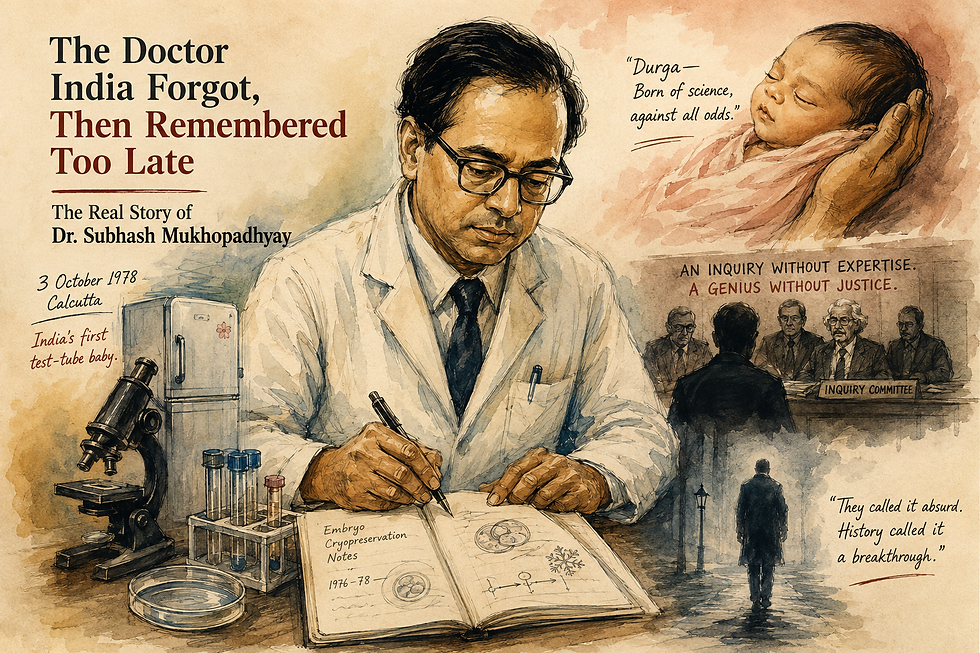
There's a photo of a little girl named Durga that occasionally makes the rounds on Indian social media every October, usually with a caption calling her "India's first test-tube baby." Almost nobody asks the follow-up question: who actually delivered her? The answer is a story that should embarrass a country more than it does. Because the man who did it — quietly, with equipment cobbled together in his own flat — was dead within three years of his achievement, driven there by the very institutions that should have been celebrating him.
His name was Dr. Subhash Mukhopadhyay. If you've never heard of him, you're not alone. That's more or less the point of this article.
Who he was, briefly
Subhash Mukhopadhyay was born on 16 January 1931 in Hazaribagh, in what's now Jharkhand, into a family that already had science in its blood — his father was a radiologist. He was a sharp student from the start: first-division marks in his matriculation from Bow Bazar High School in Calcutta, a BSc in Physiology from Presidency College, and an MBBS from Calcutta National Medical College in 1955.
He didn't stop there. He earned a PhD in reproductive physiology from Calcutta University in 1958, and then went further still, picking up a second PhD — this one in reproductive endocrinology — from the University of Edinburgh in 1967. By the time he came back to India, he wasn't just a doctor. He was one of the very few Indian scientists with deep, specialized training in exactly the field that was about to define the rest of his life, and the rest of his death.
He spent years teaching physiology at NRS Medical College in Kolkata, publishing steadily — nearly a hundred papers over his career — and working, mostly out of the spotlight, on a problem that had only just been solved anywhere in the world: how to help a woman conceive when her body couldn't do it on its own.
The work: what he actually did
On 3 October 1978, a baby girl was born in Calcutta. Her name was Kanupriya Agarwal, though the world would come to know her by her nickname, Durga. She was conceived through in vitro fertilization — an embryo created outside the body and then transferred into her mother's womb. Louise Brown, the world's first IVF baby, had been born in England just 67 days earlier. Durga was the second success on the entire planet, and the first anywhere in Asia.
Here's the part people rarely sit with: Mukhopadhyay didn't do this in a gleaming research hospital with international funding. He did it working with a small team — cryobiologist Sunit Mukherji and gynecologist Dr. Saroj Kanti Bhattacharya — using equipment that, by several accounts, included nothing more exotic than a domestic refrigerator to store and freeze the embryo at the right stage. Robert Edwards, the British scientist behind Louise Brown's birth, had a fully resourced lab and a hospital's backing. Mukhopadhyay had ingenuity, patience, and a level of technical mastery in embryo cryopreservation that, when experts finally looked at his notes years later, turned out to be genuinely ahead of what most people assumed an Indian lab of that era was even capable of.
He announced it the way any excited scientist might — first to the press, since he hadn't yet cleared it through the layers of government bureaucracy that technically outranked him. That decision, more than the science itself, is arguably what set the rest of his story in motion.
The part nobody tells you: what happened next
This is the piece of the story that almost never makes it into the celebratory retellings, and it's the reason his name isn't a household one.
The Government of West Bengal didn't send congratulations. It sent an inquiry committee. And here's the detail that still stings decades later: the committee assigned to evaluate a breakthrough in reproductive medicine and embryology did not include a single expert in reproductive medicine or embryology. It was headed by a radio-astronomer, and its other members were a nuclear physicist, a gynecologist, and a neurophysiologist. Not one of them had any real grounding in IVF.
They grilled him with questions that, from what's been recorded, ranged from irrelevant to faintly absurd — at one point reportedly asking him where, exactly, he'd "kept" the embryos, as if storing a frozen embryo were some kind of magic trick requiring a hidden compartment. At the end of it, his research was declared "unbelievable," "absurd," and ultimately "bogus." He was barred from attending international conferences to present his findings, effectively cut off from the one community that might have actually understood and validated what he'd done. Rather than support, he got professional exile — transferred first to R.G. Kar Medical College, away from his research, and later reassigned to the Regional Institute of Ophthalmology, a field that had nothing to do with his life's work.
Imagine spending years mastering an almost unheard-of technical skill, achieving something only one other team on Earth had managed, and then being handed a punishment posting in eye care because the people judging you didn't understand what you'd built.
He kept working where he could, kept trying to get his data taken seriously, and kept being met with silence or scorn instead. On 19 June 1981, in his home in Calcutta, Subhash Mukhopadhyay took his own life. He was 50 years old.
The unknown facts that make this story harder to sit with
A few details rarely surface in the short version of this story, and they're worth sitting with:
He and his wife, Namita, had made a deliberate choice not to have children of their own, so that he could dedicate himself fully to his research — a decision that makes the fate of his work feel even more painfully ironic. The man who helped bring a child into the world through science was, by his own choice, never going to have one of his own.
His vindication didn't come from the government that punished him. It came, years later, almost by accident. In 1997, Dr. T.C. Anand Kumar — himself part of the team behind India's officially recognized second IVF baby in 1986 — came across Mukhopadhyay's old handwritten notes and research papers. Reading through them, Kumar realized with something close to shock that Mukhopadhyay hadn't just attempted IVF. He had actually done it, correctly, years before anyone else in the country, using techniques that held up to real scrutiny. Kumar, to his credit, didn't stay quiet about it. He spent years afterward publicly correcting the record, insisting that credit be redirected to a man who could no longer accept it in person.
It took until 2003 — 25 years after Durga's birth, and 22 years after Mukhopadhyay's death — for the Indian Council of Medical Research to formally recognize him as the architect of the country's first test-tube baby. Durga herself, by then an adult, attended the event and said something simple and devastating: that she was proud to be living proof of the work of a genius, and that justice had finally been done to her "scientific father." His story was later included in the Dictionary of Medical Biography, published by the Wellcome Trust in London, alongside 1,100 other scientists worldwide who changed medicine. A Hindi film, Ek Doctor Ki Maut — "Death of a Doctor" — was made loosely based on his life, though by the time it released in 1990, he'd already been gone for nearly a decade.
Why we should remember him
It would be easy to file this away as a sad historical footnote — brilliant man, unjust system, tragic end, posthumous apology, the end. But that undersells what actually happened here.
Mukhopadhyay wasn't undone by a lack of talent or a failure of science. He was undone by a system that couldn't recognize expertise it didn't already understand, and that punished confidence instead of investigating it. Every one of India's IVF babies since — and there have been many hundreds of thousands — exists on a foundation he built essentially alone, in a country and era that offered him no infrastructure, no support, and ultimately no mercy.
Remembering him properly means remembering more than the achievement. It means remembering the cost of getting it right too early, in front of people not equipped to recognize it. That's not just Subhash Mukhopadhyay's story. It's a warning about what any country risks losing when it lets bureaucracy outrank expertise — and it's worth telling honestly, not as a footnote, but as a story that deserves its own chapter.


Comments